
For organisations looking to engage audiences in Wales, understanding how people consume media has never been more important. Beaufort's recent Wales Omnibus research among 1,000 Welsh adults shows a media landscape increasingly dominated by streaming services, social media and online content, but one where traditional channels continue to reach substantial audiences. The findings also reveal sharp differences between younger and older generations, underlining the importance of a targeted, multi-channel approach to communications.
The 2026 picture: digital platforms lead, but traditional media retain an important role
Facebook is the most commonly used platform on a daily basis, used by 60% of adults in Wales at least once a day. More than half, 52%, watch subscription or streaming services such as Netflix daily, while 43% use YouTube and the same proportion read news online each day.
Television remains part of everyday life for a substantial proportion of the population. Around four in ten watch commercial television channels such as ITV, S4C, Channel 4 or Channel 5 daily, while 36% watch BBC television each day. Instagram also reaches 36% daily, and a third listen to podcasts or stream music through services such as Spotify.
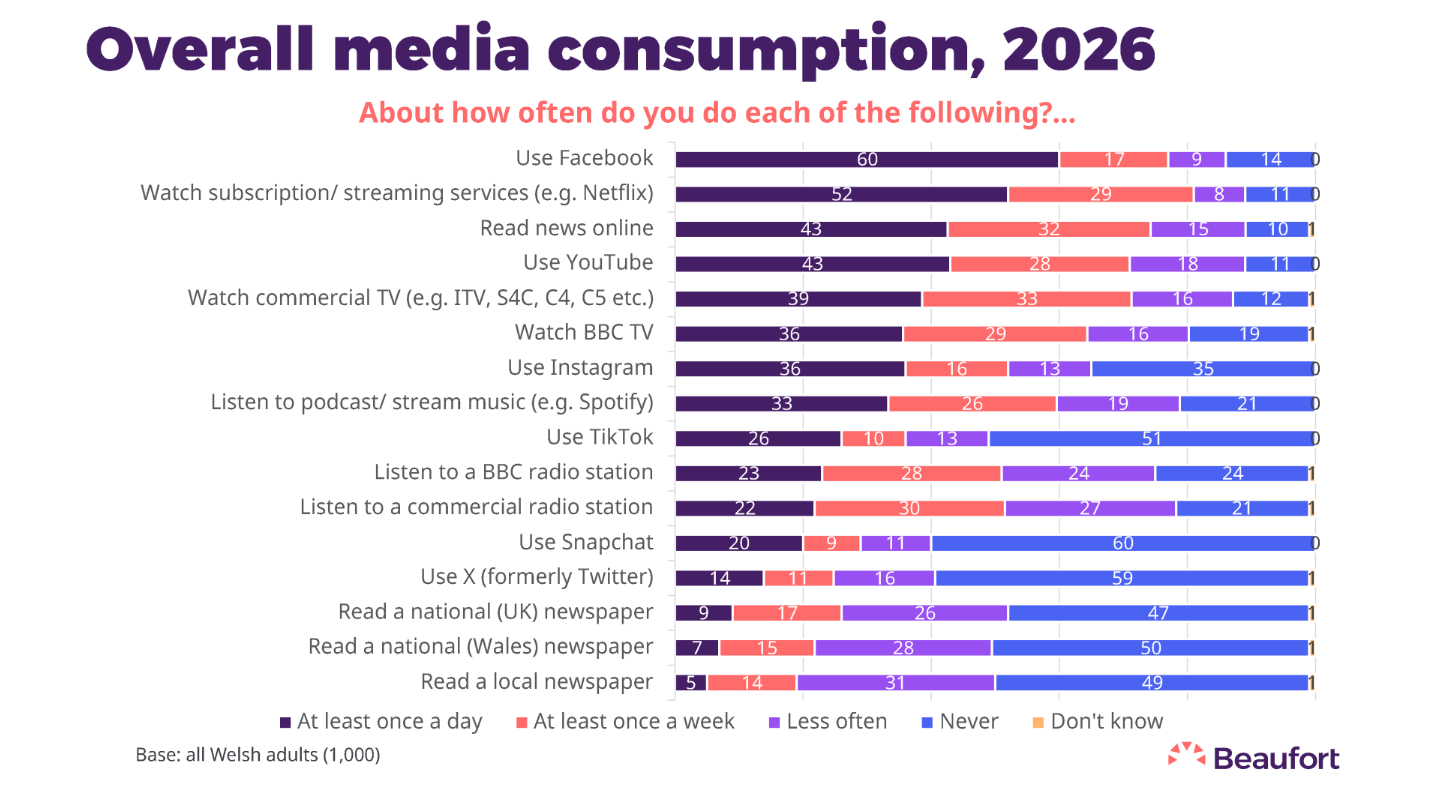
Looking beyond daily habits, Facebook and streaming services have the broadest regular reach. More than three-quarters use Facebook at least weekly, while 81% watch subscription or streaming services at least once a week. Around seven in ten regularly use YouTube or watch commercial television.
Radio continues to attract a sizeable regular audience: 52% listen to a commercial station and 51% to a BBC station at least weekly. In contrast, printed newspapers have a smaller place in people’s routines. Fewer than three in ten regularly read a local, Welsh national or UK national newspaper, and roughly half say they never read any of these.
Overall, the findings point to a diverse media environment rather than the wholesale replacement of traditional channels. Digital platforms lead in reach, but television and radio continue to play a meaningful role.
Age matters: Wales has several distinct media audiences
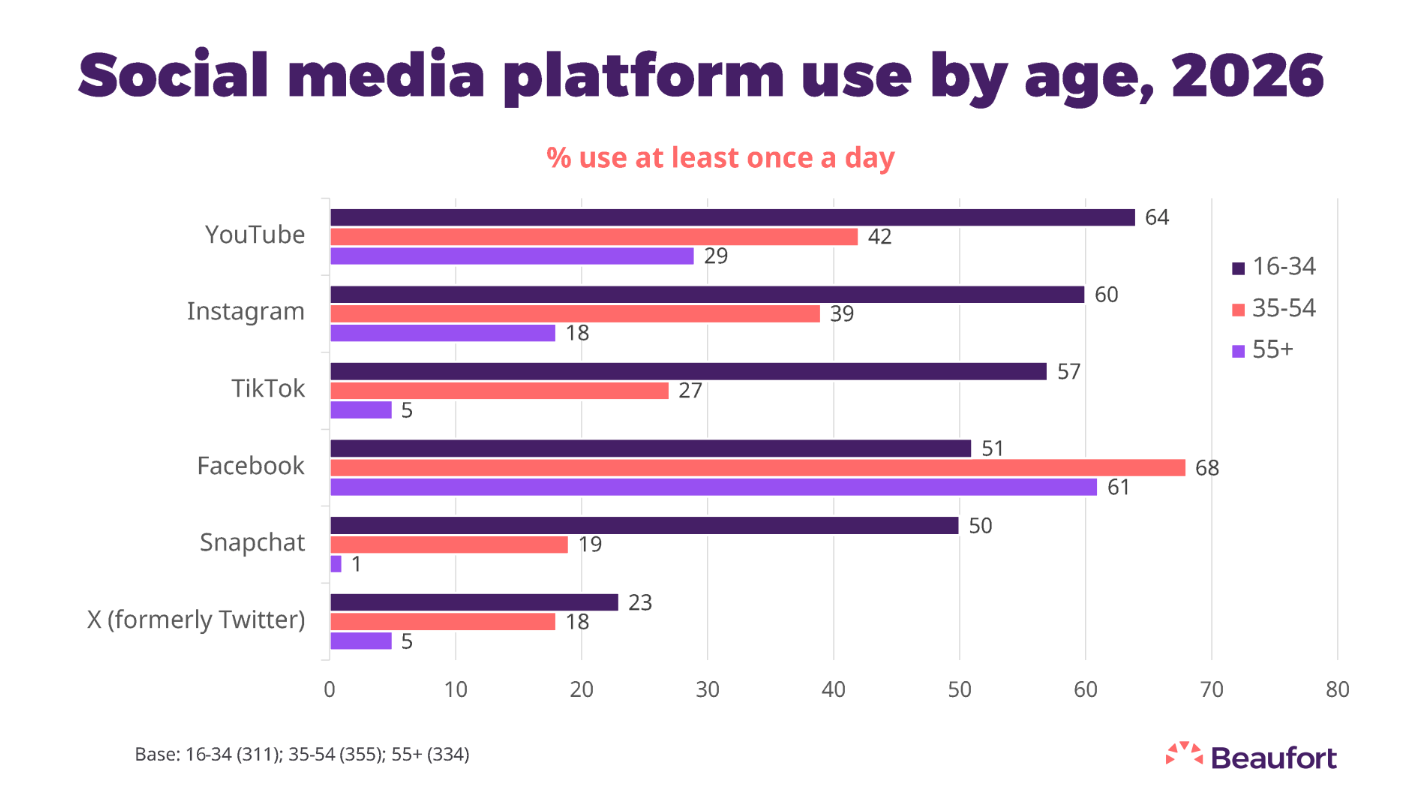
Age is one of the clearest dividing lines in media behaviour. Among 16 to 34-year-olds, YouTube is the most widely used social platform, used at least daily by 64%, closely followed by Instagram at 60% and TikTok at 57%. Half use Snapchat daily.
The pattern is very different among those aged 55 and over. Facebook is the dominant social platform for this group, used daily by 61%, but daily use of YouTube falls to 29% and Instagram to 18%. TikTok and X are each used daily by only 5%, while Snapchat reaches just 1%.
Adults aged 35 to 54 sit between these two groups, although Facebook is especially prominent among them: 68% use it daily, compared with 42% using YouTube and 39% using Instagram.
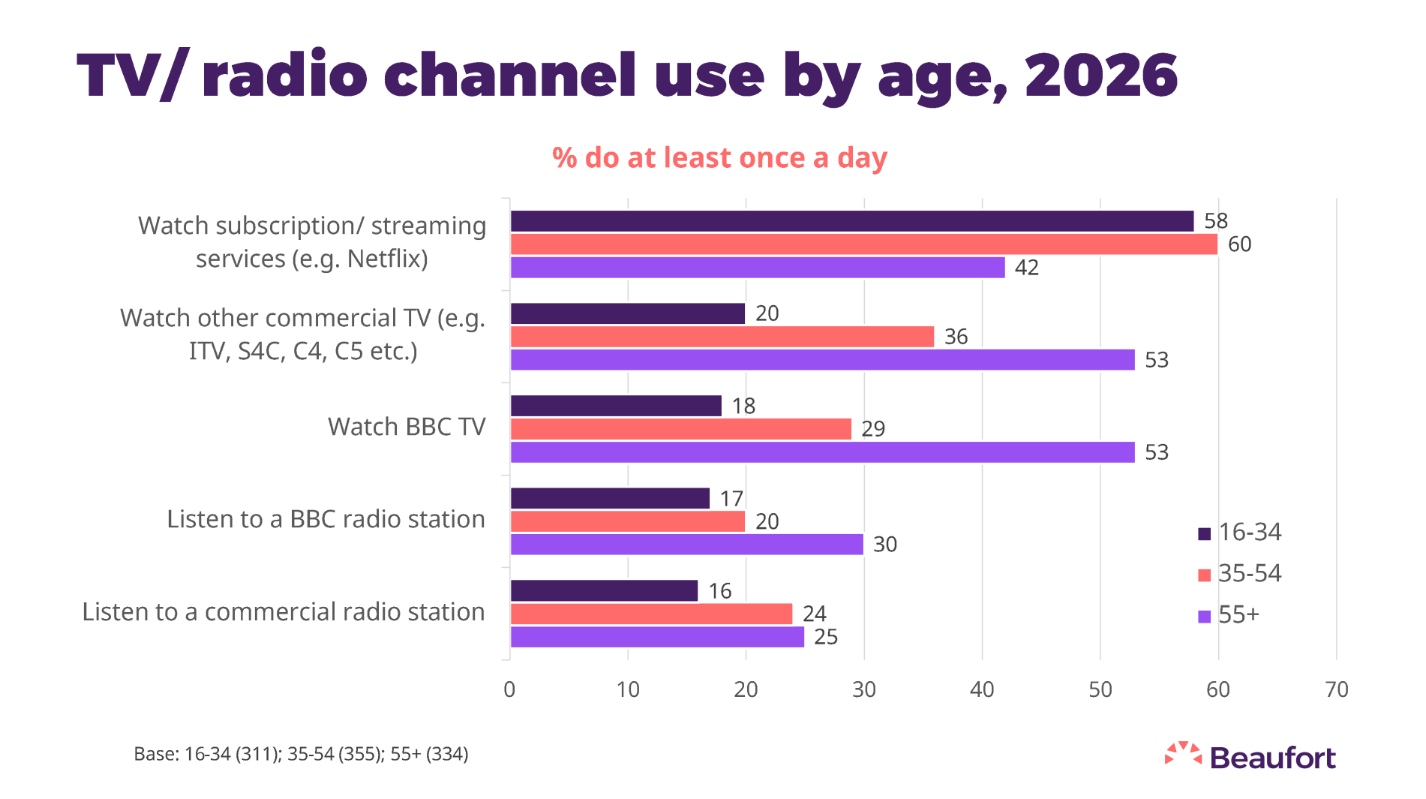
Television presents an equally marked contrast. More than half of those aged 55 and over watch BBC television or other commercial television channels daily. Among 16 to 34-year-olds, the corresponding figures are 18% and 20%.
Streaming reverses this pattern. Around six in ten adults aged 16 to 34 and 35 to 54 watch subscription or streaming services daily, compared with 42% of those aged 55 and over. Radio listening also rises with age, particularly for BBC stations.
These differences have practical implications for anyone trying to communicate with audiences across Wales. Reaching younger adults is likely to require a strong presence across video-led and social platforms, while television, radio and Facebook remain particularly important for older audiences. An effective all-age campaign therefore needs a genuinely mixed-channel approach.
What has changed since 2024?
Comparison with Beaufort’s 2024 findings suggests that regular media consumption is continuing to move towards streaming and selected digital platforms.
The proportion watching subscription or streaming services at least weekly has increased from 76% in 2024 to 81% in 2026. Weekly TikTok use has also risen, from 31% to 36%, while Instagram has increased from 48% to 52%. Facebook remains broadly stable, edging up from 76% to 77%, and YouTube has risen from 68% to 71%.
In contrast, regular consumption of several traditional media channels has declined. Weekly BBC television viewing has fallen from 74% to 65%, while commercial television has decreased from 77% to 72%. Regular listening to BBC and commercial radio has also fallen by five percentage points for each.
Newspaper readership has experienced some of the largest declines. Regular readership of UK national newspapers has fallen from 36% to 26%, while local newspaper readership has decreased from 28% to 19%. Welsh national newspaper readership has declined more modestly, from 25% to 22%. Use of X has also fallen, from 32% to 25%.

The direction of travel is clear, but it is not uniform. Streaming and visually focused social platforms have strengthened their position, whereas newspaper readership, broadcast television, radio and X have generally lost ground. At the same time, established platforms such as Facebook continue to command considerable reach.
For organisations seeking to engage people in Wales, the key lesson is not simply to “go digital”. It is to understand which digital and traditional channels matter to each audience, and to build a media mix that reflects increasingly different habits across generations.
The research was conducted among a representative sample of 1,000 adults in Wales on the June 2026 Beaufort Wales Omnibus. Comparative 2024 findings are based on a survey among a representative sample of 1,439 adults.

Have a research challenge or need insight to shape your strategy? Let’s talk! At Beaufort Research, we thrive on turning your questions into meaningful answers that drive action.


